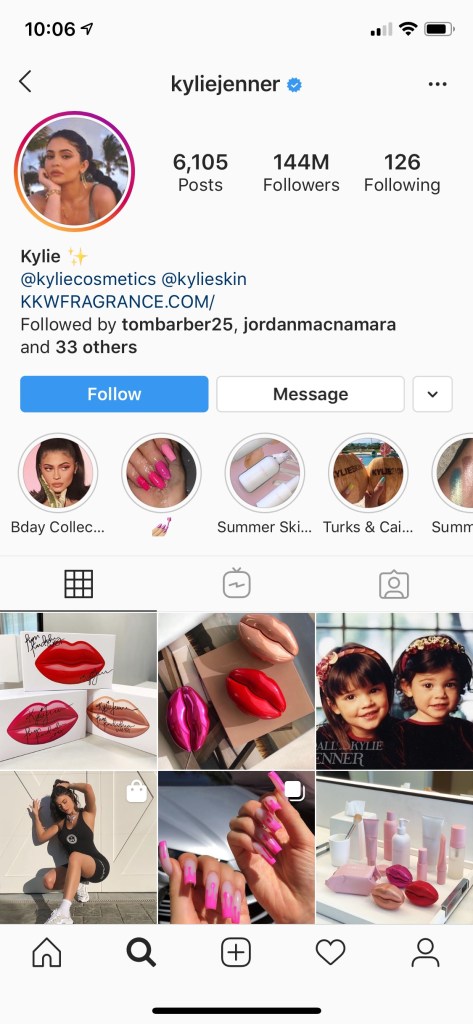
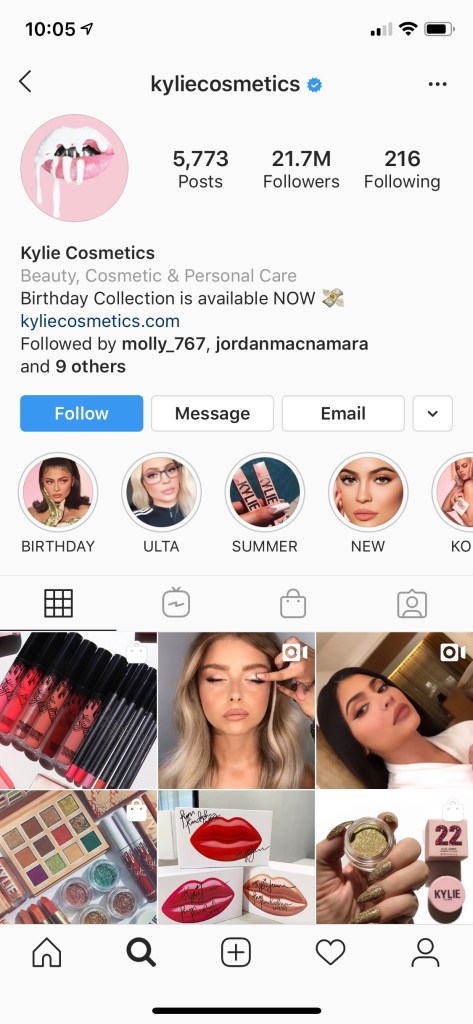
Like all things in marketing, social media should be implemented strategically, so of course there is a framework to guide us on how to implement successful use of social media. I’m going to apply the social media framework by (Felix et al 2016) to Kylie Jenners business, ‘Kylie Cosmetics’:
Scope
When Kylie uses social media, she encourages her followers to respond, interact and completely engage with her content. This ‘collaboration tool’ style appears to facilitate an environment where each post becomes a conversation that then goes on to inspire her audience to share their stories publicly through social media. Her audience responds well to this strategy, creating a strong community that ultimately boosts her brand in areas such as awareness, engagement and sales.
Culture
It’s no secret that the Kylies team believes in the power of social media, I mean, that’s the very thing that got her to where she is today. This demonstrates that they have taken the modernist approach of being open and flexible to social media, with regard to its use to enhance the brand.
Structure
With social media playing such a vital role in Kylies success, you might think that a hierarchical system where only she or her top executives have full control over content that is posted. That is not the case however, Kylie’s modernist approach to social media infers that her team would have a ‘network’ structure in which there is a level of freedom where most members of her team is responsible for social media marketing activities (Chaffey et al, 2019).
Governance
Although having creative freedom as discussed above, Kylies team would be strictly governed. This means there are a set of rules and guidelines that outlines the use of social media and identifies forms of misconduct. The purpose of governing social media activity is to protect the brand from being publicly associated with any activity that the brand does not agree with.
Now lets interpret what is happening in the financial Services industry in relation to its use of social media
Initially the industry was a bit sceptical of the big wide world of social media. They looked past any possible benefits and focused on the negatives – being that their brand could be subject to threats and ultimately be left worse off. Obviously, this wasn’t the case though, the industry now thrives off the benefits of social media as most brands have repositioned themselves away from traditional banking styles to fit in with the modern demographic.
But what does this mean?
Well traditionally banks and financial institutions were positioned as powerful figures that loomed over everyone and were in control. As society has evolved however, the banks have been put back in their place and are being held accountable for their actions by consumers. This modern environment means that financial institutions must change perceptions to be seen as a friendly community brand, that is there for you when you need them. Social media has become the obvious choice of communication channel as it facilitates an environment where institutions in the industry can remain relevant and engage directly with consumers.
Thanks to social media enabling the industry to identify opportunities and develop strategies, the industry is now presented as more inclusive, accessible and community based thus we are seeing the introduction of many of new ‘non-banks’ popping up here and there as the market has opened up and expanded.
References:
Chaffey, D. and Ellis-Chadwick, F. (2019). Digital marketing. Harlow: Pearson, pp.64-65.
Felix, R., Rauschnabel, A. and Hinch, C. (2016) Elements of strategic social media market ing: A holistic framework, Journal of business Research, 70, 118–26.
 The Weekly Digital